
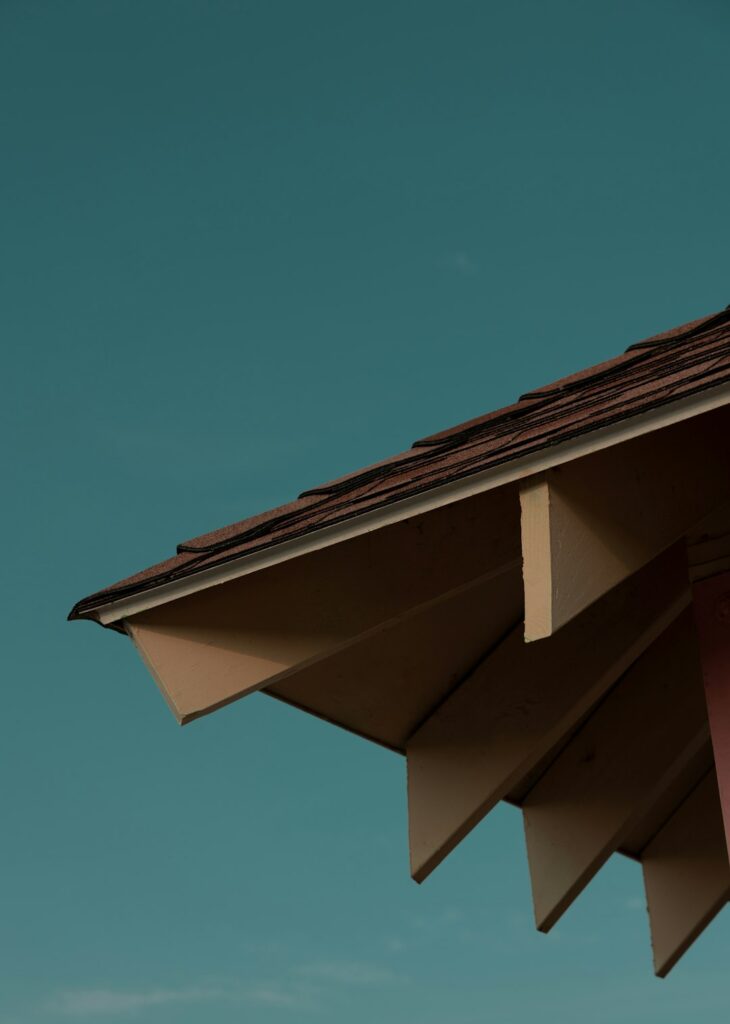
Roof eaves are the lower edges of a sloped roof that extend beyond the exterior walls. They may look like a minor architectural detail, but they help control rainwater, snow, ice, attic airflow, exterior moisture, and long-term wear around the building.
In a cold, snowy community such as Tupper Lake, properly designed and maintained eaves are especially valuable. They influence how water leaves the roof, how the attic ventilates, and how well walls, windows, siding, and foundations are protected.
What are roof eaves?
Roof eaves are the portions of a roof that project past the outside walls. The underside is often covered with a soffit, while the outer edge commonly includes a fascia board and a drip edge.
These parts work together:
- Eave overhang: Extends the roof beyond the wall.
- Soffit: Covers the underside of the overhang and may contain intake vents.
- Fascia: Runs along the roof edge and often supports gutters.
- Drip edge: Directs water away from the roof deck and into the gutter or clear of the wall.
- Gutter and downspout: Collect and carry roof runoff away from the structure.
An eave is not simply a decorative border. It is part of the roof’s water-management and ventilation system.
How do eaves protect exterior walls?
Eaves help keep rain from falling directly against siding, trim, windows, and door openings. The farther water is held away from the wall, the less opportunity it has to soak into joints, cracks, and porous materials.
This protection is useful during wind-driven rain, which can push water beneath siding or around window trim even when the roof covering itself is intact. Eaves cannot stop all wind-driven moisture, but they reduce the amount reaching the wall surface.
Over time, effective overhangs may help limit:
- Peeling paint or deteriorated exterior finishes
- Rot at window and door trim
- Staining beneath roof edges
- Moisture damage at wall sheathing
- Repeated wetting of foundation-adjacent soil
Eaves also shade portions of the upper wall and windows during warmer weather. The amount of shading depends on roof height, overhang depth, building orientation, and sun angle.
Why are eaves important for gutters and drainage?
Most sloped roofs direct water toward the eaves. Gutters installed along these edges collect runoff and carry it through downspouts.
A sound eave detail helps water move in a predictable path from the roof covering to the drip edge, into the gutter, and away from the building. Problems can occur when the drip edge is missing, the gutter is poorly positioned, or the roof edge has sagged.
Water that misses the gutter may run behind it and soak the fascia or soffit. Water that exits too close to the wall can repeatedly wet siding and collect near the foundation. In areas with substantial winter precipitation, this pattern may be hidden by snow for months before damage becomes visible.
Downspouts should discharge far enough away from the foundation to avoid creating a concentrated wet area beside the basement or crawlspace wall. The exact arrangement depends on grading, paving, drainage systems, and local site conditions.
How do eaves affect attic ventilation?
In many vented attics, air enters through soffit vents at the eaves and exits through higher roof or ridge vents. This creates a natural airflow path beneath the roof deck.
Soffit intake vents are most effective when they are not blocked by insulation, paint, debris, insect screens, or poorly installed coverings. Air channels, sometimes called baffles, help preserve a clear passage from the eave into the attic.
Adequate airflow can help remove heat and moisture from the attic. Moisture may enter from household activities such as bathing, cooking, drying clothes, or using a humidifier. If that moisture remains trapped, it can contribute to damp insulation, mold growth, wood deterioration, and frost on the underside of the roof deck during very cold weather.
Ventilation must be balanced with air sealing and insulation. Adding a vent in one location does not automatically solve an attic moisture problem. Warm indoor air leaking through ceiling penetrations can remain a major source of condensation even when soffit vents are present.
What is the connection between eaves and ice dams?
Ice dams form when snow on the warmer upper portions of a roof melts and the water refreezes near the colder eaves. The resulting ice ridge can block drainage, allowing water to back up beneath shingles or other roof coverings.
Eaves are where this problem becomes visible because they are exposed to colder outdoor temperatures and often extend beyond the heated wall line. Poor attic insulation, air leakage, blocked soffit vents, uneven roof temperatures, and heavy snow can all contribute.
The eaves themselves do not cause ice dams. However, their design and condition affect how melting water drains and where ice accumulates.
Useful warning signs include:
- Thick bands of ice along the lower roof edge
- Icicles combined with interior water stains
- Water marks on soffits or fascia
- Damp insulation near the roof perimeter
- Repeated leaks during thawing weather

Removing roof ice from the ground with improvised tools can damage shingles and create a fall hazard. Roof-edge ice and heavy snow also place extra weight on the eave framing and gutter system.
What eave problems should homeowners watch for?
Many eave problems are visible from the ground. A seasonal inspection can look for:
- Sagging gutters or separated gutter joints
- Loose, cracked, or missing soffit panels
- Peeling paint or soft wood on fascia boards
- Dark staining beneath the roof edge
- Rusted or displaced drip edge
- Birds, insects, or rodents entering through damaged vents
- Roof shingles that curl, lift, or stop short of the edge
- Water flowing behind gutters during rain
Interior clues matter too. Check attic areas near the eaves for damp wood, compressed insulation, frost, mold-like staining, or daylight where it should not be visible.
Older homes may have enclosed eaves with limited ventilation, while newer construction may use continuous soffit vents. Neither arrangement is automatically good or bad. Performance depends on the complete roof and attic assembly.
Do larger eaves always provide better protection?
No. A deeper overhang can provide more wall protection and shade, but it also adds structural demands and may be more exposed to wind, drifting snow, falling branches, and ice. The appropriate size depends on the roof design, wall height, climate, snow and wind exposure, and the way gutters are supported.
Very shallow eaves may provide little protection from rain. Very deep eaves may require additional framing or careful detailing. The goal is a well-supported edge that handles water and snow without creating new weak points.
When does an eave problem require prompt attention?
Immediate attention is justified when water is entering the attic or living space, a gutter is pulling away from the roof, fascia wood is visibly collapsing, or snow and ice are creating a dangerous overhang above an entrance or walkway.
Repairs involving steep roofs, heavy snow, unstable ladders, electrical hazards, or structural damage can be unsafe for untrained homeowners. In those situations, safety and building-code requirements should take priority over routine maintenance.
A well-functioning eave quietly performs several jobs at once: it moves water away from the walls, supports drainage, provides a pathway for attic air, and helps the roof respond to snow and freezing temperatures. Keeping the soffit, fascia, drip edge, gutters, and roof edge working as one system is more effective than treating any single part as an isolated feature.
